


Long-Term Reliability in Hermetic Optoelectronics: Controlling Moisture, Hydrogen and VOCs

As optoelectronic and communication technologies become increasingly compact and sophisticated, device reliability depends not only on the performance of individual components, but also on the environment in which they operate.
Optical transceivers, RF modules and other sensitive optoelectronic devices are often enclosed in hermetic packages designed to protect their internal components from the external environment. However, sealing a package does not necessarily mean that its internal atmosphere will remain unchanged throughout the device lifetime.
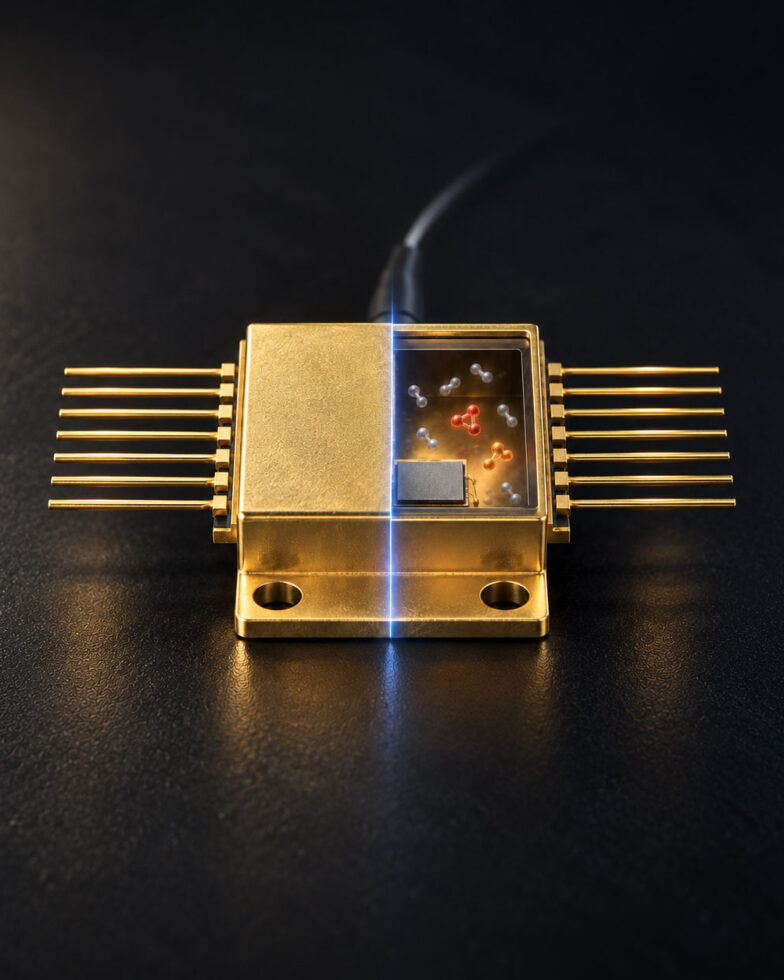
Residual gases, material outgassing and species generated after sealing can progressively alter the environment inside the package. Among them, hydrogen, moisture and volatile organic compounds (VOCs) can represent critical factors for long-term device stability.
What happens inside a hermetic package after sealing?
Hermetic packaging provides a highly effective barrier between a sensitive device and the external environment. Yet gaseous contaminants may already be present inside the package at the time of sealing or may be released by materials and components over time.
Different species can originate from different mechanisms.
Hydrogen may be released by metals and metal plating or generated through processes involving moisture.
Moisture can remain as a residual contaminant after manufacturing and assembly or be released by materials inside the package.
Residual gases, material outgassing and species generated after sealing can progressively alter the environment inside the package. Among them, hydrogen, moisture and volatile organic compounds (VOCs) can represent critical factors for long-term device stability.
Why internal atmosphere control matters in optoelectronics
Optoelectronic devices increasingly support communication infrastructures in which reliability and consistent performance are essential.
Optical transceivers, for example, convert electrical signals into optical signals and vice versa, enabling high-speed data transmission through fiber-optic networks. RF modules perform a similarly critical function in wireless communication systems by transmitting and receiving radio-frequency signals.
These devices often combine different materials, coatings, electronic components and assembly processes within a very limited volume.
Over time, gaseous contaminants released inside the package may interact with sensitive surfaces and components, potentially contributing to changes in electrical or optical characteristics and ultimately affecting device stability and lifetime.
For this reason, hermetic sealing alone may not always be sufficient.
An additional gas-management function can be integrated into the package to continuously control detrimental species after sealing.
From discrete getters to integrated gas management
Getter materials are specifically designed to capture gases and maintain controlled environments inside sealed devices.
Traditionally, a getter may be introduced into a package as a separate component. However, miniaturization and increasingly complex device architectures make space, assembly simplicity and integration important design considerations.
An alternative approach is to integrate getter functionality directly into a structural part of the package.
The lid is particularly suitable for this purpose. It is already required to close the package and provides an available surface on which a functional getter coating can be applied.
This approach transforms the lid from a passive packaging component into an active part of the internal atmosphere management system.
ZeDry Lid: integrated control of hydrogen, moisture and VOCs
ZeDry Lid is a SAES getter solution developed for hermetic optoelectronic devices.
The technology consists of a high-capacity, solventless getter material coated directly onto the package lid and designed to capture hydrogen, moisture and volatile organic compounds.
ZeDry combines different sorption mechanisms within the same integrated solution.
Hydrogen is irreversibly sorbed, while moisture and VOCs are reversibly sorbed by the material, which means the ZeDry getters can be re-activated if the lid has been exposed to atmosphere, regaining all their nominal getter capacity.
By integrating the getter directly onto the lid, ZeDry Lid provides a plug-in approach to gas management without requiring the addition of a separate loose getter component inside the device.
The solution can therefore support package designs where integration simplicity, available internal volume and contamination control are particularly important.
Integrating functionality without adding loose components
Direct getter integration into the lid offers several advantages from a packaging perspective.
First, the getter functionality is incorporated into a component that is already part of the device architecture. This can simplify integration compared with the introduction and fixation of a separate getter element.
It also eliminates loose getter particles inside the package and enables the getter function to be positioned according to the package configuration.
For manufacturers developing compact optoelectronic systems, this approach can help combine gas-sorption performance with increasingly demanding packaging requirements.
The result is not simply a lid with an additional coating, but a functional packaging component designed to actively contribute to the stability of the internal environment throughout the device lifetime.
Discover our ZeDry Lids

Different internal environments require different getter strategies
Not every hermetic device has the same internal atmosphere requirements.
For applications where hydrogen, moisture and VOC management is the primary challenge, ZeDry Lid provides an integrated getter solution designed specifically for these species.
Vacuum-packaged devices require a different approach.
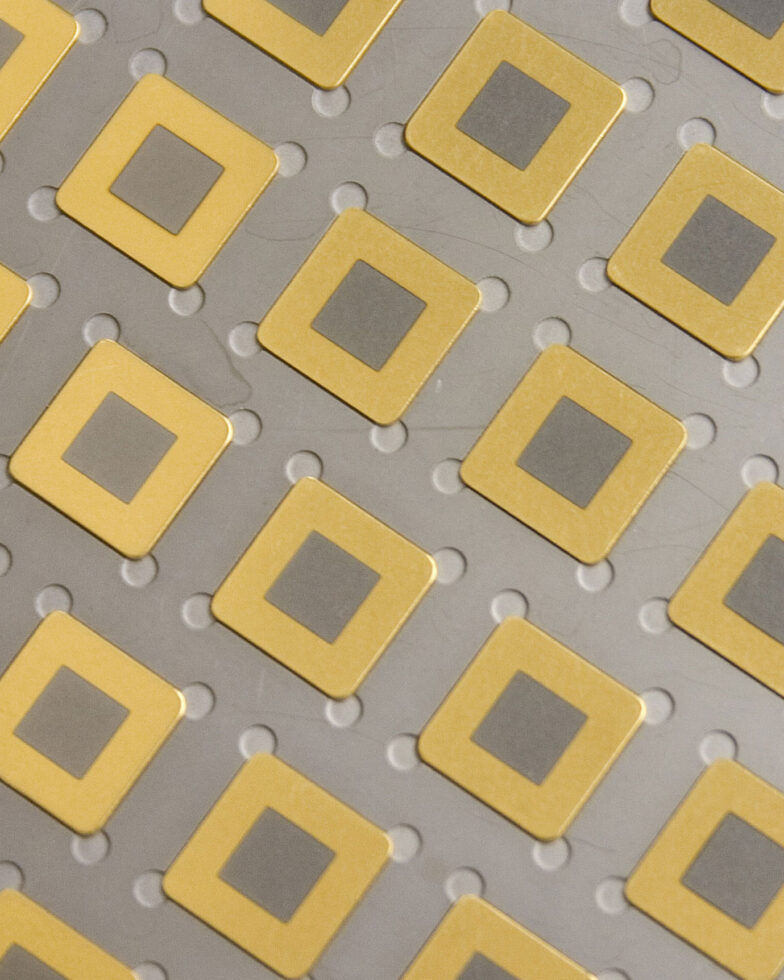
For these applications, SAES PaGe Lid technology integrates a getter film onto metallic, ceramic, glass or germanium lids, in customer-defined patterns. The getter film supports the maintenance of suitable vacuum conditions by chemically sorbing active gases including water, oxygen, carbon oxides, nitrogen and hydrogen.
Both technologies apply the same underlying design principle: integrating getter functionality directly onto the package lid.
The specific getter technology, however, is selected according to the atmosphere that must be maintained inside the device.
Discover our PaGe Lids
Supporting high-reliability optoelectronics
As communication and optoelectronic systems continue to evolve, devices are expected to combine increasing performance with compact dimensions and long operating lifetimes.
Under these conditions, packaging becomes more than a protective enclosure.
Its materials, internal atmosphere and ability to manage contaminants can directly contribute to device reliability.
By integrating gas-sorption functionality directly into the lid, getter-coated lid technologies offer designers a way to actively manage the environment inside hermetic devices without adding separate components.
Long-term reliability therefore depends not only on keeping the external environment out, but also on controlling what remains — and what develops — inside the package after sealing.


