


Maintaining Vacuum Stability in Synchrotron Optics: The SOLARIS DCM example

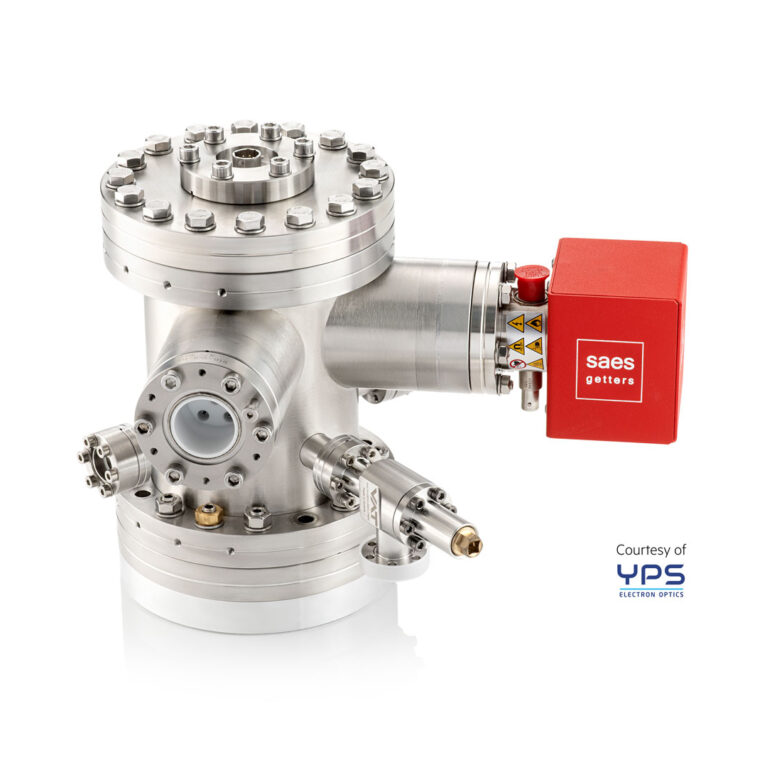
NEXTorr® HV 300: performance meet reliability.
In hard and soft X-Ray synchrotron beamlines, where precision and long-term reliability are crucial, maintaining a stable and clean high vacuum is one of the main requirements to avoid detrimental contamination of the optics.
At PolyX beamline – National Synchrotron Radiation Centre SOLARIS, this task was successfully met with a single NEXTorr® HV 300 pump integrated into the water-cooled double-crystal Si monochromator with multilayer mirrors designed and built by Strumenti Scientifici Cinel.
For more than 2.5 years, this compact getter–ion hybrid pump kept the operational vacuum stable in the mid E-7 mbar range — without any bake-out of the monochromator, without neither additional auxiliary pumps nor cryocooling and with no maintenance required.
A remarkable demonstration of the reliability and efficiency of SAES High Vacuum’s products.

Reliable vacuum under challenging conditions
The monochromator environment presents multiple outgassing sources — optics, actuators, mechanical components, and cabling — and is routinely operated without any bake-out, thus water vapor and surface contaminants typically compromise vacuum levels.
Despite the enhanced gas load, a single NEXTorr HV 300, with a weight of just 3.1 kg and an extremely compact size, maintains high vacuum stability for prolonged time, ensuring constant beamline performance, no contamination of the optics and long-term reliability.
This result highlights the pump’s exceptional pumping speed for hydrogen and active gases, as well as its sustained sorption capacity, conferred by the ZAO HV getter alloy, allowing for long operational periods even in demanding environments.
Compact, energy-efficient design that protects optical integrity
Operating with only a few watts of power, the NEXTorr HV 300 ensures no thermal load irradiated on mirrors or crystals, maintaining full cleanliness of the optics.
Its compactness also simplify the installation, making the pump ideal for tight spaces or retrofitting in existing beamline setups.
By eliminating the need for auxiliary pumps, the system benefits from lower vibration, reduced noise, and improved mechanical stability, which are key factors for synchrotron instrumentation.
No maintenance, maximum uptime
One of the main advantages for research facilities is the absence of maintenance.
The SOLARIS monochromator has run continuously for more than two and a half years without any single intervention — minimizing operational costs and maximizing beam time availability for scientists.
When reactivation is finally needed, the process is fast and user-friendly: the NEG element is simply heated for one hour to fully restore its pumping capacity.
This can be easily done by a single operator, with no impact on experimental schedules.

Proven results and customer satisfaction
The simplicity of use, reliability, and compactness of the NEXTorr HV 300 translate directly into long-term stability and scientific productivity.
For synchrotron facilities like SOLARIS, it means fewer interruptions, lower costs, and more time dedicated to research.
“Working with these pumps is a very nice experience.”
SOLARIS Team

Enabling next-generation performance in synchrotron vacuum systems
The SOLARIS case confirms the NEXTorr HV 300 as a benchmark solution for maintaining stable high vacuum conditions in hard x-ray optical and beamline systems — combining compact design, negligible power consumption, and long-term reliability.
By integrating SAES High Vacuum’s ZAO alloy, research centers can achieve reliable performance, minimal maintenance, and optimized uptime — key parameters for high-end scientific facilities.
Discover our advanced solutions